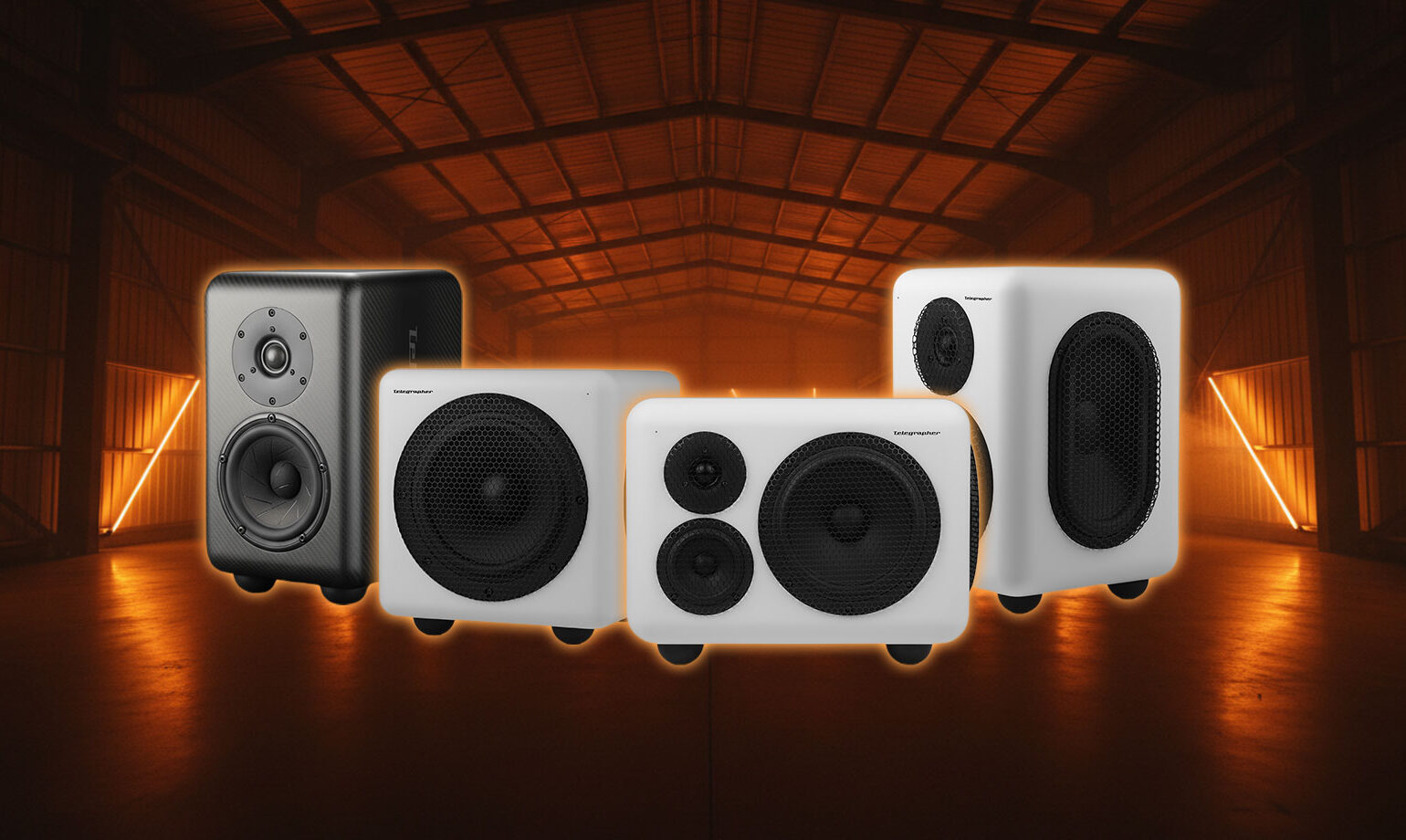
Telegrapher’s announcements put the spotlight on four additions to its professional monitoring range: three new designs—Raccoon, Panda, and Hippo—plus an upgraded iteration of the brand’s established Carbon Fox. Built around Telegrapher’s all-analogue approach, the new models aim to deliver accurate translation for DJs, producers, and engineers who need dependable reference monitoring across studio, home, and touring environments.
Rather than chasing novelty for its own sake, Telegrapher positions this release cycle as an evolution of core design choices, including crossover development informed by extensive R&D and a passive radiator architecture intended to improve low-frequency performance while limiting distortion and unwanted artifacts. The company also emphasizes practical durability, with protective grilles designed to be acoustically transparent so they safeguard drivers without compromising transient response or clarity.
Design Philosophy: All-Analogue Crossovers and Passive Radiator Architecture
Across the 2024 lineup, Telegrapher continues to center its engineering around all-analogue signal paths and crossover networks developed through ongoing research and refinement. The brand’s newer crossover work is presented as a key factor in achieving controlled driver integration and predictable tonality—both critical requirements for mixes that translate reliably beyond the studio.
A consistent technical thread across the newly introduced monitors is the use of passive radiators. In Telegrapher’s framing, this approach supports efficient low-frequency air movement while avoiding the typical side effects associated with conventional ports, such as turbulence or audible port noise. Founder and Chief Designer Emre Telci summarizes the objective as maintaining accuracy and control in the low end, with an emphasis on real-world monitoring conditions.
To support daily professional use, Telegrapher also highlights its protective grilles, described as acoustically transparent. The idea is to combine physical protection with minimal impact on dispersion, detail, and transient behavior—an increasingly relevant consideration for setups that move between rooms or travel in production environments.
Raccoon: Compact Two-Way Nearfield Monitor for Precision Listening
The Raccoon arrives as a two-way nearfield reference monitor, designed for close-range placement where detail and midrange neutrality are essential. Telegrapher describes the Raccoon’s passive radiator system as a way to achieve a controlled low-frequency response without the drawbacks associated with ported designs. In practical terms, the goal is a low end that remains articulate and stable at nearfield distances, while the midrange stays neutral enough for decision-making during mixing, editing, and sound design.
For producers and DJs working in space-limited studios, the Raccoon is positioned as a compact cabinet that aims to exceed expectations in bass authority relative to its size. The emphasis remains on balanced monitoring rather than hyped voicing, prioritizing clarity, imaging, and dependable translation.
Panda: Three-Way Mid-Field Monitor Built for Scale and Separation
Moving up in size and intended listening distance, the Panda is presented as a three-way mid-field reference monitor designed to deliver scale, separation, and clarity. With a dedicated midrange driver alongside its low-frequency system, the Panda targets environments where engineers and producers monitor from farther back, and where maintaining coherent detail across the spectrum becomes more challenging.
Telegrapher again relies on passive radiator loading for low frequencies, describing the result as deep and accurate bass without compression or turbulence. In the context of mid-field monitoring, that focus suggests the Panda is aimed at users who need both weight and definition—particularly when balancing kick and bass relationships, low-mid density, and overall mix dynamics at a more immersive listening distance.
Hippo: Subwoofer Designed for Clean Integration and Fast Transient Response
The Hippo expands the lineup with a dedicated subwoofer intended to pair with Telegrapher’s nearfield and mid-field monitors. Its passive radiator architecture is described as producing fast, controlled sub-bass with strong transient response and precise pitch definition. That combination is relevant for modern electronic music workflows, where the clarity of sub information can influence not only mix balance, but also arrangement decisions and sound selection.
Telegrapher differentiates the Hippo from traditional ported subwoofers by emphasizing the avoidance of common low-end artifacts associated with ports. The brand’s stated objective is a clean, focused low-frequency foundation that integrates seamlessly, supporting monitoring accuracy without introducing additional noise, turbulence, or perceived “blur” in the sub region.
Carbon Fox: Upgraded Enclosure Design for Rigidity, Reduced Resonance, and Portability
Rounding out the NAMM 2024 announcements, the Carbon Fox is introduced as an enhanced version of the original Fox monitor. The upgrade centers on a fully carbon-fiber enclosure with constrained-layer damping, described as increasing rigidity while reducing resonance. Telegrapher frames the Carbon Fox as a product of extensive touring experience, designed to withstand real-world use while preserving the trusted sonic character that existing users expect.
From a practical standpoint, the carbon-fiber build is also positioned as lighter and more durable—an advantage for professionals who move their monitoring setups between studios, performance contexts, or mobile production environments. Co-founder and CEO Erce Kaslioglu connects the update to how users operate across different workflows, emphasizing that the new lineup responds to evolving professional needs.
Pros and Cons
Pros
- All-analogue design approach across the new lineup, with crossovers developed through ongoing R&D
- Passive radiator architecture used throughout the releases, aiming to support controlled low-frequency performance while minimizing common port-related artifacts
- Model range covers nearfield, mid-field, and subwoofer use cases, supporting scalable monitoring setups
- Acoustically transparent protective grilles are presented as balancing physical protection with clarity and transient response
- Carbon Fox features a carbon-fiber enclosure with constrained-layer damping, intended to increase rigidity, reduce resonance, and improve durability
Cons
- Pricing and availability details have not been announced at the time of Telegrapher’s NAMM 2024 release information
- No official product video link was provided in the source material, so buyers may need to rely on the manufacturer’s site for the latest media updates
Pricing and Availability
Telegrapher has not yet announced pricing or availability for the Raccoon, Panda, Hippo, and updated Carbon Fox. For shoppers who want to track listings as they appear, the following retailer searches can be useful starting points.
More Info
Get more info on the official Telegrapher website.
Conclusion
With the Raccoon, Panda, and Hippo joining an upgraded Carbon Fox, Telegrapher’s NAMM 2024 lineup aims to cover a wider range of monitoring needs—from compact nearfield setups to mid-field critical listening and dedicated sub-bass reinforcement. The consistent focus on all-analogue design, R&D-driven crossover development, and passive radiator architecture underscores the brand’s priority: controlled, accurate translation in real working environments. As pricing and availability details emerge, these models are likely to draw attention from producers, DJs, and engineers looking for a coherent monitoring ecosystem built around clarity, low-end control, and practical durability.