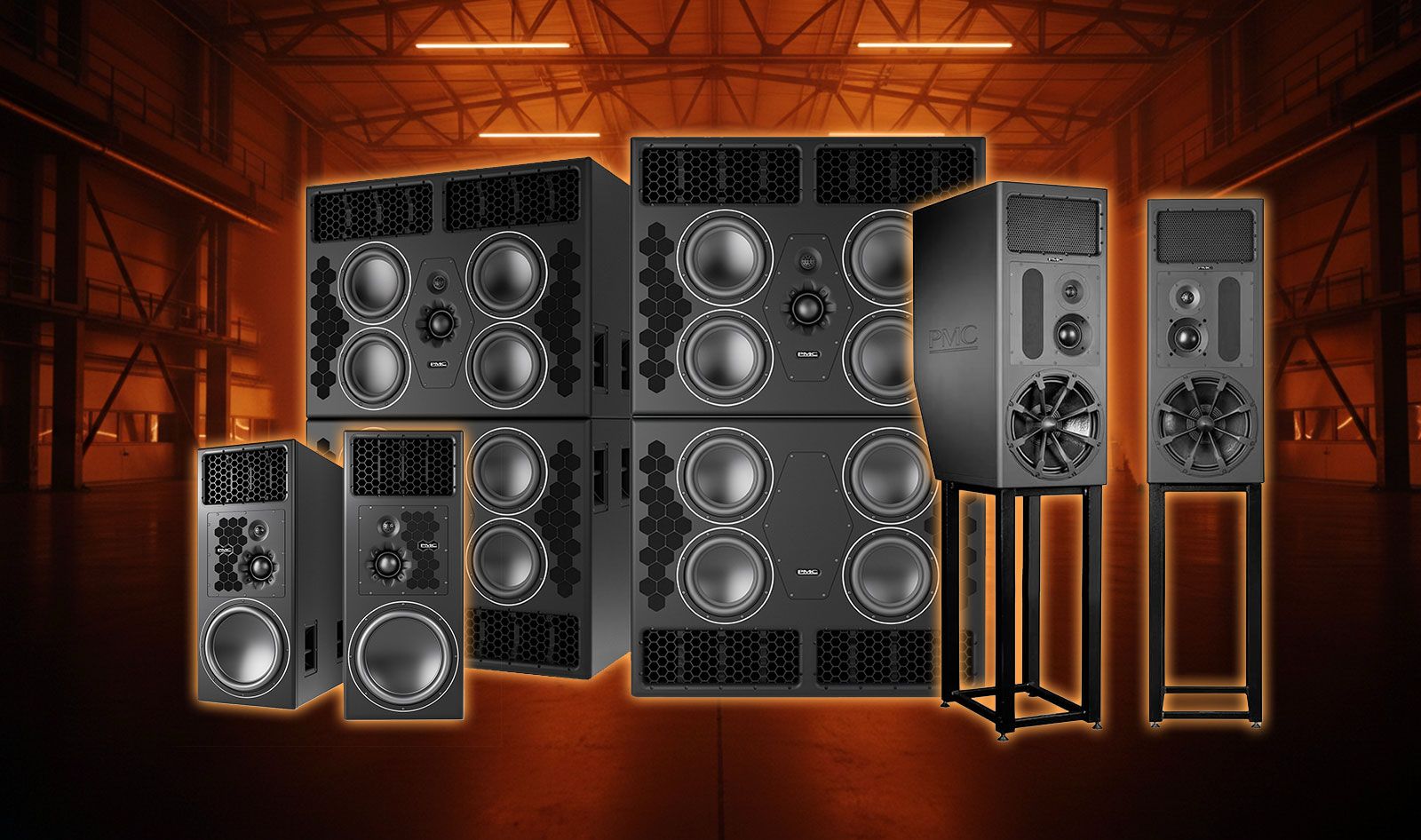
Unveiled at NAMM 2026 to celebrate PMC’s 35th anniversary, the new PMC Main Monitor Series marks a major milestone for the British loudspeaker manufacturer. This launch introduces a completely reengineered family of flagship studio monitors, designed to address the technical requirements of today’s music production, post-production, and immersive audio environments.
As the first full redesign of PMC’s main monitoring systems in more than three decades, the Main Monitor series reflects a long-term vision focused on precision, scalability, and consistency across complex professional workflows.
A Fully Reimagined Monitoring Platform
The Main Monitor series has been designed entirely in-house, allowing PMC to rethink every aspect of its monitoring architecture. From driver development to system integration and software control, the platform has been conceived as a unified solution rather than a collection of individual components.
This approach results in improved clarity, reduced distortion, and greater headroom, ensuring reliable performance in demanding studio conditions. The system is intended to serve as a long-term reference for engineers working across stereo, surround, and immersive audio formats.
Advanced Low-Frequency Engineering
Low-frequency performance plays a central role in the Main Monitor series. PMC has developed a new generation of large-format bass drivers specifically optimized for its Advanced Transmission Line (ATL) bass-loading technology.
These drivers feature heavily vented motor assemblies, dual-spider suspensions, and triple-wound voice coils offering up to 36 mm of linear excursion. This significant increase in controlled driver movement allows for deeper, more stable bass reproduction, even at high sound pressure levels. The result is a low-end response that remains natural, controlled, and highly informative for critical listening tasks.
Precision Midrange and High-Frequency Reproduction
Midrange duties are handled by the newly developed PMC75v3 soft-dome driver. Its damped acoustic chamber reduces unwanted rear-wave reflections, leading to lower distortion and improved transient response. This design delivers a clear and accurate midrange, essential for vocals, dialogue, and detailed mix elements.
Sound dispersion is managed by PMC’s proprietary n-compass dual-profile waveguide, which helps maintain a stable soundstage and consistent tonal balance across a wide listening area. High frequencies are reproduced by a hand-built 34 mm soft-dome HF driver with a low-distortion motor system and optimized waveguide geometry, ensuring a smooth top end and reduced listening fatigue during long studio sessions.
Integrated DSP, Amplification, and Control
Each model in the Main Monitor series integrates PMC’s latest DSP and amplification platform. Central to this system is the updated SoundAlign2 software, paired with the new master36 system controller.
Using any standard web browser, engineers can configure individual monitors or entire systems, including room integration, equalization, delay alignment, polarity management, crossover optimization, and preset control for installations of up to 32 speakers.
The master36 is housed in a compact 3U chassis and combines 32-bit DSP crossover processing with six high-efficiency Class-D amplifiers delivering a total output of 3600 W. It supports both analog and digital inputs and offers full network-based control. For larger systems, the power20 unit adds an additional 2000 W of Class-D amplification in a matching 3U format.
Flexible Models and System Scalability
The Main Monitor series is available in four models: PMC10, PMC12, PMC15, and PMC10-4. All models are fully active three-way designs and can operate as standalone full-range monitors or be expanded using matching XBD bass cabinets to increase low-frequency headroom.
Standalone subwoofers based on the same driver technology are also available, allowing systems to be tailored to different room sizes and production formats. Thanks to consistent voicing and dispersion across the range, the Main Monitor series integrates seamlessly into surround and immersive audio environments, supporting scalable system design without compromising tonal coherence.
Pros and Cons
The Main Monitor series stands out for its fully redesigned in-house architecture, advanced ATL-based low-frequency system, and integrated DSP platform offering precise system control through a browser-based interface. Its modular design allows it to scale from high-end stereo setups to large immersive installations while maintaining consistent sonic performance.
However, this level of sophistication is primarily aimed at professional studios with advanced technical requirements. The system’s complexity and premium positioning may exceed the needs of smaller project studios or entry-level production environments.
Pricing and Availability
The PMC Main Monitor series is positioned in the high-end professional monitoring segment. Pricing varies depending on model and system configuration.
Conclusion
With the Main Monitor series, PMC introduces a new reference platform that reflects 35 years of acoustic research and real-world studio experience. By combining advanced driver technology, powerful DSP-based control, and a modular system approach, this new range is designed to meet the most demanding professional production standards.
Whether used for music mixing, film scoring, or immersive audio workflows, the PMC Main Monitor series establishes a new benchmark for accuracy, consistency, and control in high-end studio monitoring.