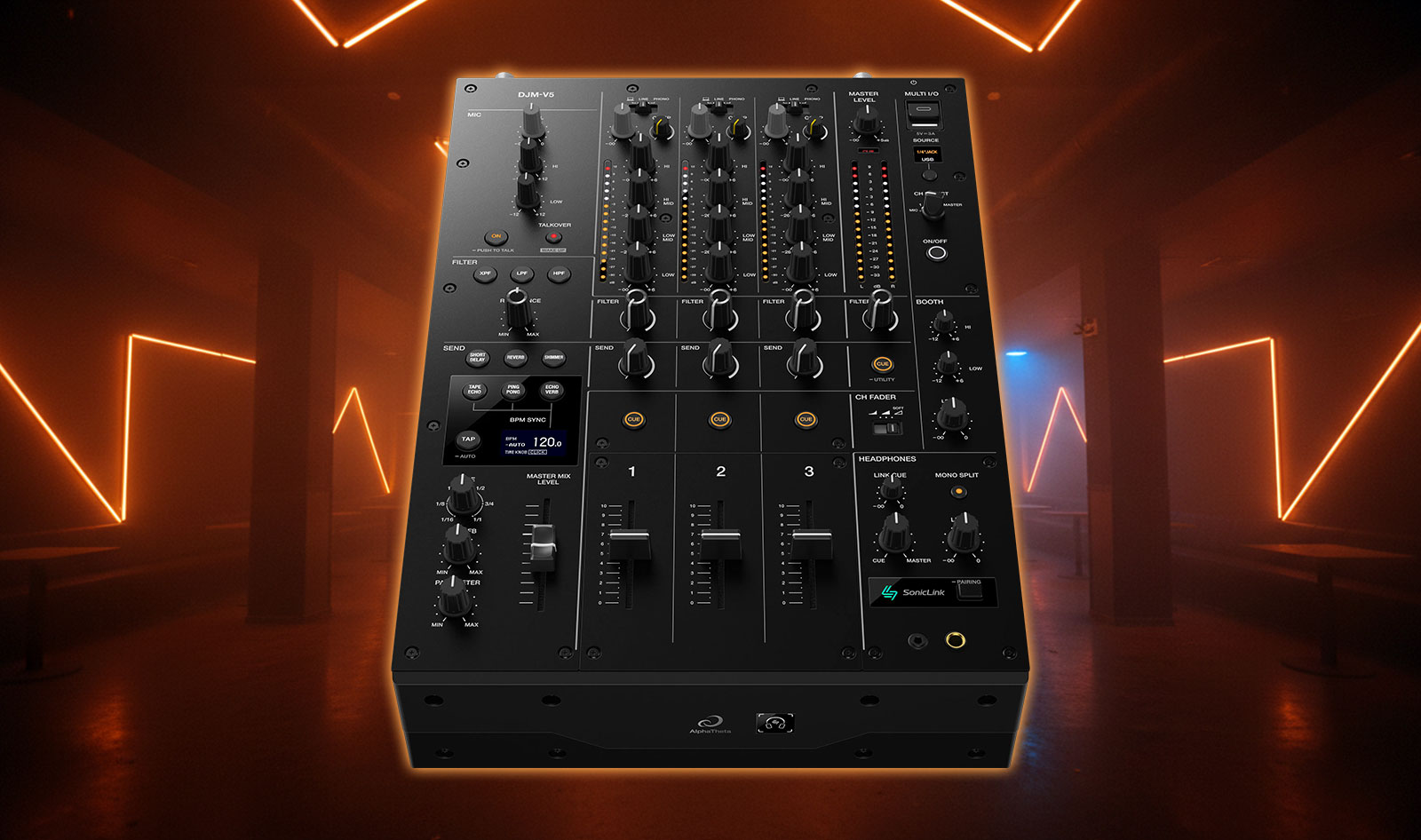
AlphaTheta (ex Pioneer DJ) releases the DJM-V5, a compact, 3-channel “V10-style” DJ mixer that leans hard into sound shaping, smooth blends, and modern connectivity for DJs who care more about how mixes feel than how loud the feature list looks
There’s a certain type of DJ mixer that doesn’t try to impress you in the first five minutes. No fireworks, no endless effect buttons, no immediate “wow” moment. Instead, it reveals itself slowly — in the way tracks sit together, in how EQ moves feel under your hands, and in how long blends seem to breathe rather than fight. The DJM-V5 very clearly wants to be that kind of mixer.
Rather than shrinking a flagship club mixer and calling it “compact,” AlphaTheta has taken a more opinionated approach here. The V5 borrows ideas from the DJM-V10 — particularly its focus on sound shaping and smooth transitions — but strips away anything that doesn’t directly support that philosophy. The result is a mixer that feels less like a performance weapon and more like an instrument for mixing itself.
First impressions: compact, but not “lite”
At first glance, the DJM-V5 looks reassuringly familiar. The layout won’t surprise anyone who’s spent time on modern Pioneer/AlphaTheta mixers, and that’s a good thing. You immediately know where your hands are supposed to go. But spend a few minutes looking closer and it becomes clear this isn’t just a downsized club mixer.
The three-channel layout is the first hint. This is not aimed at four-deck maximalism or controller-style routines. Instead, it feels designed for DJs who work with two main tracks and a third source — an acapella, a drum loop, an external device, or a safety deck. It’s a layout that encourages intention rather than excess.
Physically, the mixer sits in an interesting middle ground: compact enough for smaller booths or studio desks, but still heavy and solid enough to feel like it belongs in a professional environment rather than a bedroom setup.
Key Features
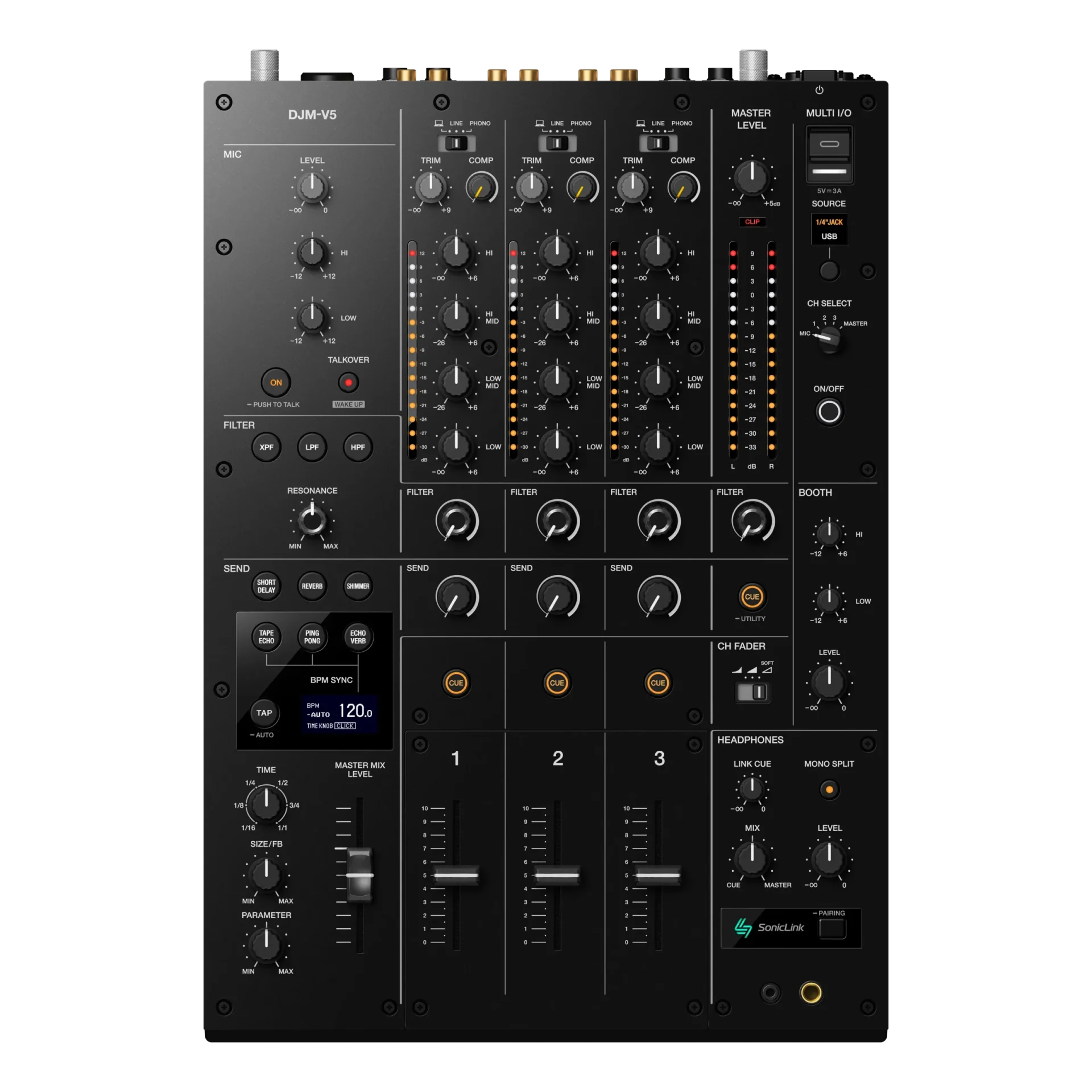
- 4-Band EQ on every channel
Inherited from the DJM-V10, the 4-band EQ offers precise frequency control, making it easier to shape mixes, balance overlapping tracks, and fine-tune transitions.
- 60 mm long-throw channel faders with Soft Mix Curve
Long-throw faders allow for more controlled, gradual blends. The Soft Mix Curve subtly manages high-frequency overlap as you raise the fader, helping transitions feel smoother and more natural.
- 6 Send FX for spatial and rhythmic control
Includes Short Delay, Reverb, Shimmer, Tape Echo, Ping Pong, and Echo-Verb. Each channel features a dedicated send knob, while the time control adapts per effect, combining BPM-sync with smooth manual adjustment.
- 3 filter modes, including cross-pass filter
Alongside standard low-pass and high-pass filters, the cross-pass filter shapes mids and highs while preserving low-end energy—useful for adding movement without thinning the mix.
- Built-in SonicLink wireless monitoring
Integrated SonicLink transmitter enables ultra-low-latency wireless headphone monitoring. Pairing is quick and cable-free, helping keep booths clean and changeovers smooth.
Where the DJM-V5 really starts to make sense: EQ and dynamics
The core of the V5 experience isn’t found in its effects section — it’s in how it handles tone and balance.
The 4-band EQ is the star of the show. On paper, it’s just an extra band compared to the standard 3-band layout. In practice, it changes how you mix. Instead of choosing between cutting bass or shaving mids, you can make smaller, more musical moves. Vocals can sit cleaner, low-mids can be controlled without killing warmth, and transitions feel more intentional rather than corrective.
Add the per-channel compressor, and the V5 starts to feel especially friendly to DJs with wide or unpredictable libraries. Older tracks, quieter masters, or dynamically uneven material can be gently brought forward without constant trim riding. It’s not flashy, but it’s the kind of feature you appreciate more the longer your set goes on.
This is where the V5 shows its lineage most clearly: it’s designed to help tracks coexist, not compete.
Faders and filters: subtle tools that reward patience
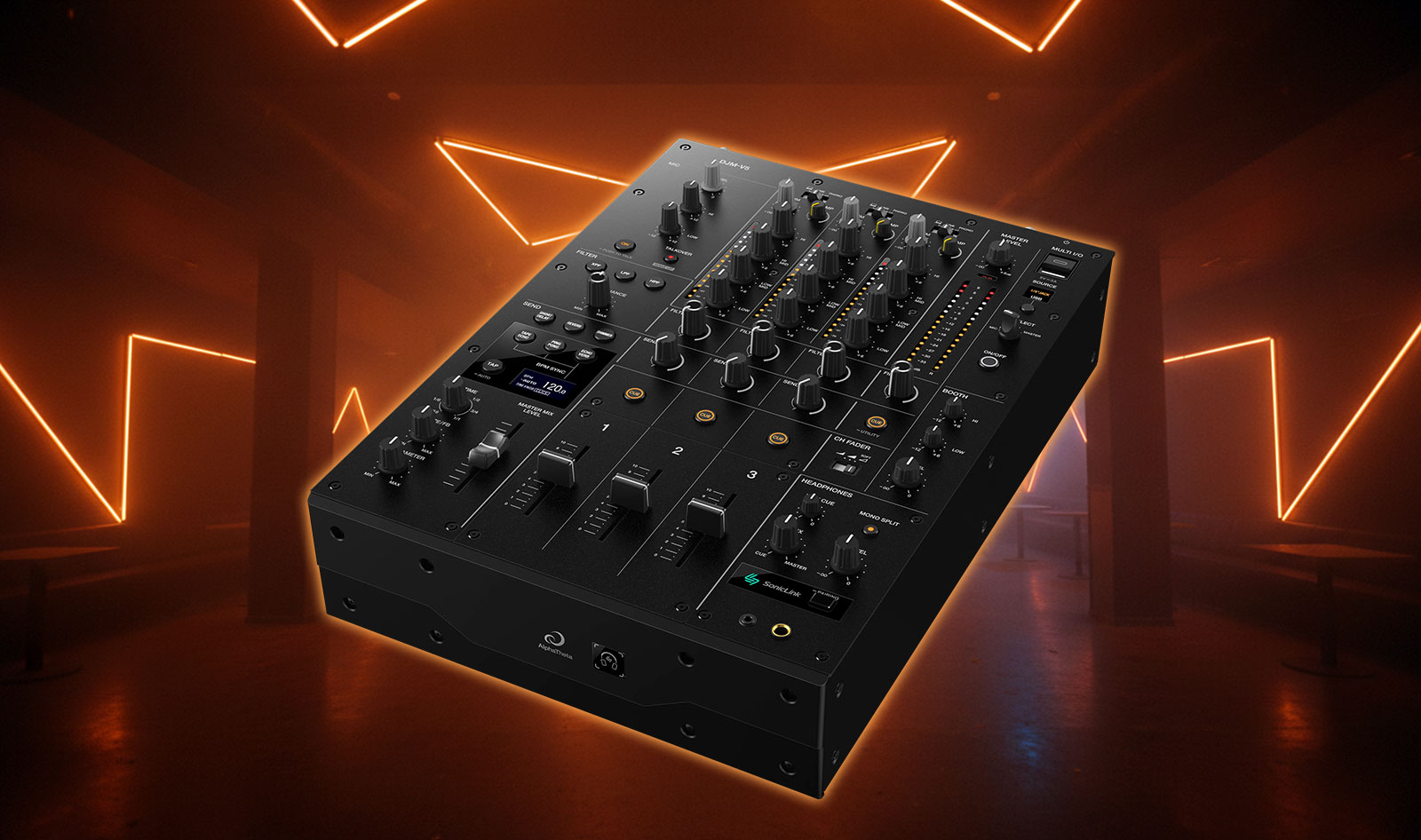
AlphaTheta has clearly put a lot of thought into how transitions feel on the V5. The long-throw channel faders give you more physical resolution, which matters if you’re the kind of DJ who mixes gradually rather than slamming tracks in.
The new Soft Mix Curve feature reinforces that idea. As you bring a new track in, the mixer subtly manages high-frequency overlap, reducing that harsh moment where two bright tracks clash. It’s not something you “hear” as an effect — it’s something you notice when blends just feel smoother than expected.
The filters continue this understated approach. Alongside familiar low-pass and high-pass options, the V5 introduces a cross-pass filter designed to let you shape mids and highs while keeping the low end intact. In real-world mixing terms, this means you can create movement and tension without draining the energy from the room.
Again, nothing here screams for attention — but everything supports long, controlled transitions.
FX: a deliberate shift in priorities
This is the point where some DJs will either nod in agreement or raise an eyebrow.
The DJM-V5 does not include the traditional Beat effects section found on many club mixers. Instead, it leans heavily into send-based effects like delays, reverbs, and echo variations. These effects are designed to add space and texture rather than rhythmic stunts. The philosophy is clear: effects are meant to enhance the mix, not dominate it.
If your style relies on heavy Beat FX routines, quick build-ups, or dramatic drops, the V5 may feel restrained. But if you prefer subtle echoes, washes of reverb, and effects that live around the music instead of on top of it, this approach makes a lot of sense.
It’s a mixer that assumes the tracks — and your mixing decisions — are the main event.
Modern booth realities: connectivity and SonicLink
While the V5’s mixing philosophy feels almost old-school in its restraint, its connectivity is very much modern.
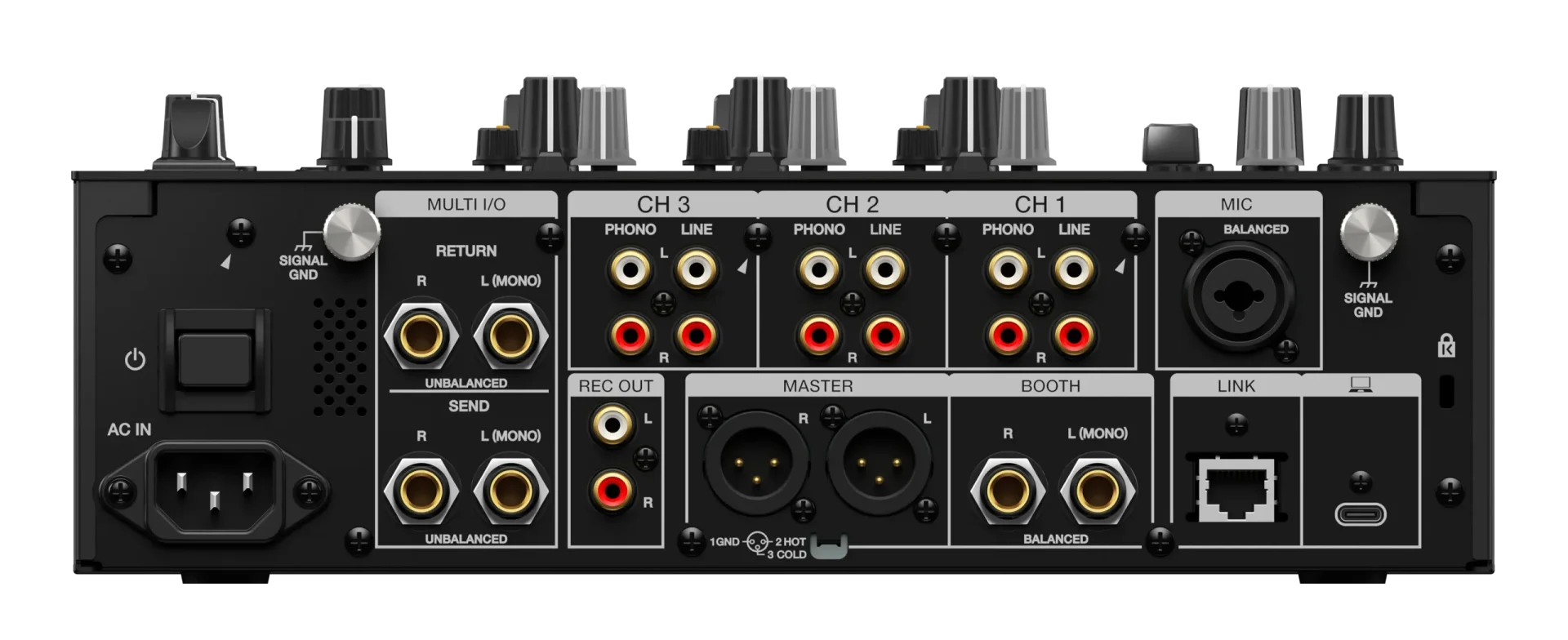
Dual USB-C ports, DVS support, Pro DJ Link integration, and hardware send/return options make it easy to slot into both club booths and hybrid setups. DJs running external effects, iOS devices, or mixed digital/analog rigs will appreciate the flexibility.
One of the more forward-thinking additions is SonicLink, AlphaTheta’s low-latency wireless monitoring system. In theory, it’s a solution to one of the most annoying booth problems: headphone cables that snag, twist, or get yanked during changeovers. Whether wireless monitoring becomes the norm remains to be seen, but having it built directly into the mixer feels like a glimpse of where booth design might be heading.
Who the DJM-V5 is really for
The DJM-V5 feels designed for DJs who see mixing as a craft, not a performance trick.
It’s at its best in genres where long blends, careful EQ work, and subtle energy control matter — house, techno, disco, melodic, and deeper styles in general. DJs who enjoy shaping a journey rather than delivering constant peaks will likely feel at home here.
On the flip side, DJs who need four full channels, rely heavily on Beat FX, or want maximum feature density for performance routines may find the V5’s focus a little too narrow, BUT you can still level up your game adding the new RMX Ignite if you really wanna go big on SFX, enjoying its sampler feature as well.
Our thoughts:
The AlphaTheta DJM-V5 doesn’t try to be everything, and that’s exactly the point.
It’s a mixer that prioritizes how music blends, breathes, and evolves over how impressive the spec sheet looks. By focusing on EQ precision, dynamics, smooth transitions, and tasteful effects, it offers a mixing experience that rewards patience and control.
For DJs who value feel over flash, the DJM-V5 isn’t just a compact mixer — it’s a clear statement about what modern mixing can be when less really is more.
AlphaTheta DJM-V5 enters the market at: £1,739 / $1,999 / €1,999
Pros and Cons:
✅ Pros
- V10-inspired sound shaping: 4-band EQ + compressor + refined filter options
- Smooth-mix focus: 60mm faders and Soft Mix Curve are aimed at better blends
- Expressive Send FX palette: musical, space-oriented effects with thoughtful control behavior
- Modern connectivity: dual USB-C, DVS support (rekordbox/Serato), Pro DJ Link
- SonicLink built-in: wireless monitoring is a genuinely modern booth feature
⚠️ Cons / Trade-offs
- No Beat FX section (by design)
- Only 3 channels: not ideal for standard 4-deck workflows
- Hands-on questions remain: the “Soft Mix Curve” and cross-pass filter sound great on paper, but real-world feel will matter most
📷 Cover Photo Credit : Courtesy of AlphaTheta